
Alumni Stories – February 2026
Voices of RMBL: Kara Cromwell
In 2012, I spent my first summer at Rocky Mountain Biological Laboratory (RMBL), and it was often a lonely one. My research project was streamlined enough that I didn’t need a field crew, and no other graduate students from my program at the University of Wisconsin worked in Gothic. I spent early mornings and late nights alone at the microscope examining mayflies for parasitism, focused on a narrow field of view. I didn’t yet anticipate how my world at RMBL would grow, continually stretched wider by the people who shared my fascination with the place, what it teaches us, and how we can give back to it.
Now, almost a decade after completing my dissertation work in Gothic, I keep coming back. I return for the science and the place, but mostly for the people. Some are collaborators and friends I know well. Others I never met, but their legacy continues to shape the culture of RMBL in palpable ways.
Dr. Scottie Willey comes to mind; her first RMBL summer was 54 years before mine, in 1958. In my imagination she’s a figure of mythic proportions, vying against relentless forces — profit-seekers extracting minerals and water from the wild headwaters that were both the subject of her work and, it seems, home to her soul. Her love of the wild forged her into a ferocious defender of wholeness: of landscapes guarded from degradation and fragmentation.
Science was one of the tools she used to protect what mattered to her, but her work at RMBL was never only about data. It was full-hearted, intent on improving the world around her. Like any mythic heroine on a quest, she offered her accomplishments in service to her community.
When a brief window of opportunity opened to legally protect instream flow rights in the East River drainage, Scottie worked alongside her husband, Bob, and water-rights attorney Pete Klingsmith to secure the water right for RMBL, ensuring that these ecologically vital headwaters would continue to flow.
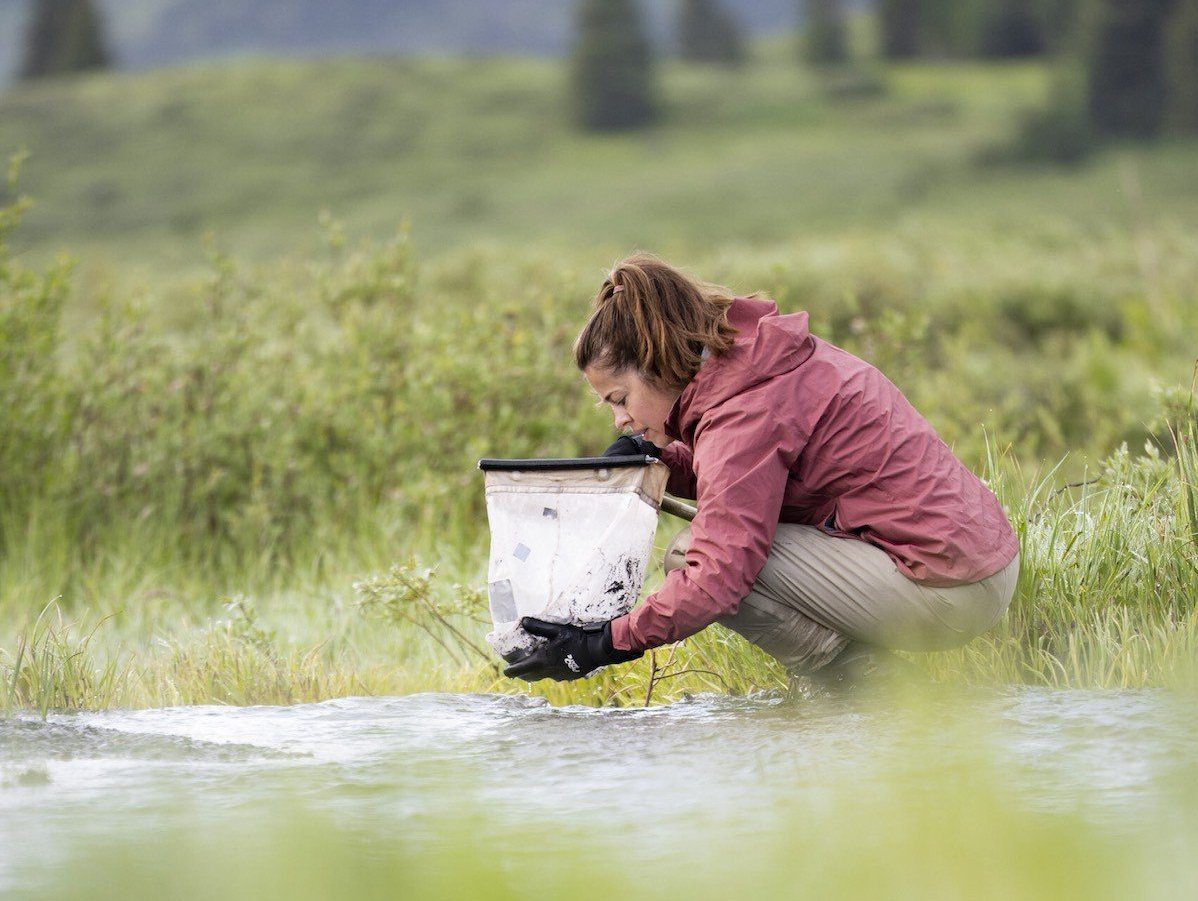
That work did not end with Scottie’s generation. The torch was carried forward by Bobbi Peckarsky, who continued this work after Scottie and introduced it to me, inviting me into a lineage of care for these headwaters. Today, I continue to collect data and work alongside the RMBL community to help sustain the instream flow right and to share why healthy headwaters matter — not only ecologically, but socially and culturally as well. To help ensure this work has stability into the future, Bobbi and I co-founded Rocky Mountain Rivers, building a framework to support watershed science, stewardship, and community engagement over the long term.
Through examples like this — and through the work I continue today — I learned at RMBL that community is the force that alchemizes scientific objectives into a deeply held sense of purpose. Knowledge gains its power when it moves outward to inform stewardship, shape decisions, and strengthen communities.
The lineage of “Benthettes,” of which I’m a part, is one expression of a broader RMBL culture shaped by researchers who pair scientific rigor with care for place and community. It is a way of doing science grounded in relationship and responsibility. At RMBL, I learned that science, in every respect, is better when it is shared.
— Kara Cromwell, PhD
RMBL Alumna
Kara Cromwell holds a PhD in Ecology from the University of Wisconsin–Madison, where her research focused on environmental drivers of disease in high-altitude streams around RMBL. She now lives in Missoula, Montana, where she consults with environmental organizations to make ecology research and education meaningful to community stakeholders. She also continues aquatic parasitology research and teaching as affiliate faculty at the University of Montana. Last year, she and RMBL collaborators co-founded Rocky Mountain Rivers, a nonprofit that uses science to inspire wonder and inform stewardship of rivers in the Rocky Mountains and beyond.
Photo: Dr. Kara Cromwell sampling macroinvertebrates from the East River as part of a long-term project to monitor biodiversity and protect instream flow rights of the East River’s headwaters